
Sleeve gastrectomy is one of the most commonly performed weight-loss procedures worldwide, and in recent years, advanced sleeve surgery techniques have begun to change how the procedure is performed. One such development is single-stapler technology, which is designed to perform the main gastric resection using a single long firing sequence rather than multiple sequential staple loads.
For patients considering sleeve gastrectomy in Dubai, this is an important advancement to understand because surgical efficiency is about more than speed. It is about achieving the required precision with fewer unnecessary steps.
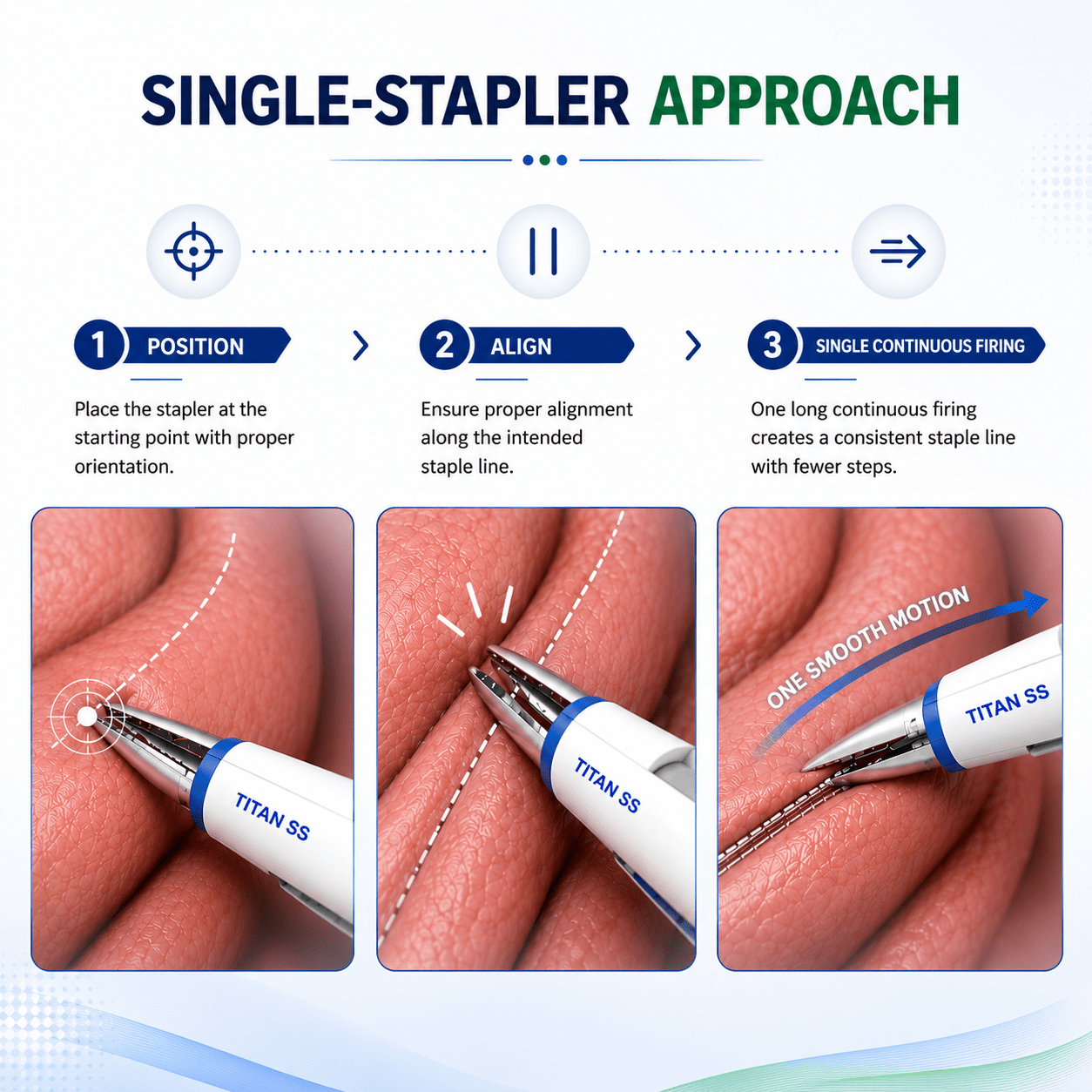
What Is a Single-Stapler Sleeve Gastrectomy?
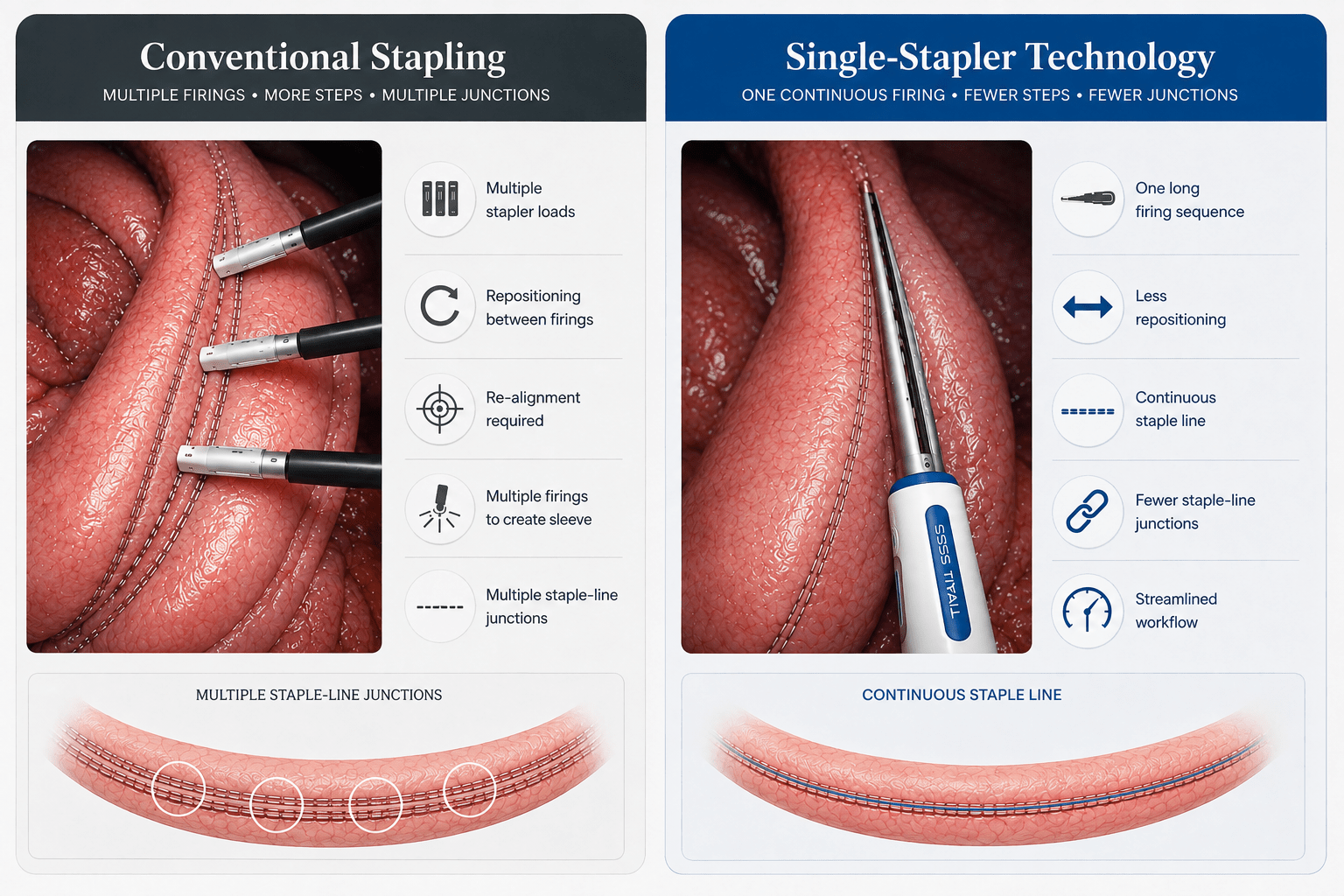
During a conventional laparoscopic sleeve gastrectomy, the surgeon uses multiple stapler loads to divide and reshape the stomach into a narrow sleeve.
With single-stapler technology, a long stapling device is designed to perform a substantial portion of the gastric resection in one continuous firing sequence.
The basic difference can be understood as:
Conventional stapling:
Multiple staple loads → Repositioning → Alignment → Additional firings
Single-stapler approach:
One long firing sequence → Continuous staple line → fewer positioning steps.
The objective is to simplify the stapling stage of the procedure rather than to rush the operation.
Where Does Time Go During Traditional Sleeve Gastrectomy?
Traditional sleeve gastrectomy is an established surgical approach. Multiple stapler firings are used because the stomach must be divided progressively along the planned sleeve.
Each additional firing can involve several steps:
- Positioning the stapler
- Aligning it with the planned resection
- Firing the stapler
- Removing the device
- Repositioning it for the next section
- Aligning the new staple line with the previous section
- Repeating the process
The process can therefore be represented as:
Position → Align → Fire → Remove → Reposition → Repeat
Single-stapler technology is designed to reduce some of these repeated steps.
Importantly, this does not mean conventional multi-fire stapling is unsafe or ineffective. It remains a widely established technique in sleeve gastrectomy.
What Are the Potential Benefits of Single-Stapler Technology?
Single-stapler technology may make sleeve gastrectomy more streamlined by reducing repeated firings, repositioning, and staple-line junctions, while potentially shortening operative time.
Here’s how these potential benefits can make the stapling process simpler:
1. Fewer Stapler Firings Mean Fewer Surgical Steps
The most direct efficiency benefit is the reduction in the number of firings. With conventional stapling, each additional cartridge requires the surgical team to repeat the positioning and firing process. With a single-fire system, the main gastric resection can be performed with a single long firing sequence.
That means :
- Stapler: fewer repositioning steps
- No Cartridge changes
- Once locked, No Alignment checks between separate loads
- No Transitions between staple-line sections
The goal is not simply to reduce the number of devices. It is to reduce repeated actions during the stapling stage.
2. A 23-cm Continuous Staple Line Can Reduce Junctions
One example of this approach is the Titan SGS, a single-use surgical stapler designed with a 23-cm staple line. This design can eliminate the junctions that would otherwise occur where separate staple loads meet.
With conventional stapling:
Multiple staple loads → multiple junctions
With continuous firing:
One long staple line → no junctions
Experimental research cited in the source found that the single-load design eliminated staple-line junctions while maintaining appropriate staple formation and mechanical integrity.
3. Less Repositioning Can Streamline the Operating-Room Workflow
Every additional firing requires the stapler to be removed, repositioned, and realigned. Reducing these movements can streamline the stapling stage.
Why does this matter?
- Less instrument movement
- Fewer cartridge changes
- Fewer alignment steps
- Smoother coordination within the operating room
The potential time savings are therefore not only in the firing itself. It can also come from reducing the steps between firings.
Can Single-Stapler Technology Shorten Operating Time?
Early clinical evidence suggests single-stapler technology may reduce overall operating time. In a 2024 retrospective study, matched procedures had a median operative time of 47 minutes with the Titan SGS versus 55 minutes with sequential stapling.
What did the study find?
- 807 sleeve gastrectomy procedures used the Titan SGS.
- 3,829 procedures used sequential stapling.
- After propensity matching:
- 47 minutes: Titan SGS
- 55 minutes: Sequential stapling
- Difference: 8 minutes
The study also reported shorter hospital stays and fewer 30-day readmissions in the single-fire group. However, this was a retrospective study, so it cannot prove that the stapler itself caused these differences. Patient characteristics, surgical technique and other factors may also influence outcomes.
Also note that the approximately one-minute (55 seconds exactly) Titan SGS firing time refers to the firing sequence, not the total sleeve gastrectomy procedure.
Does Greater Efficiency Mean Fewer Sleeve Gastrectomy Complications?
Not necessarily. Single-stapler technology is primarily designed to improve the efficiency of sleeve creation. It does not eliminate risks such as bleeding, leakage, infection, narrowing or reflux.
What does the available evidence show?
- The 2024 retrospective study found similar postoperative bleeding rates between the groups.
- Some other short-term outcomes favoured the single-fire group.
- An earlier multicentre study of 61 patients reported successful use of the device, with one postoperative haemorrhage requiring surgery.
- One study showed that it reduces leak rate & also postoperative nausea and vomiting
What Does This Mean for Patients Seeking Sleeve Gastrectomy in Dubai?
For patients searching for sleeve gastrectomy in Dubai, understanding the technology behind the procedure can make a consultation more meaningful.
Rather than asking only, “Which stapler do you use?”, patients can ask:
- How does the stapling technology affect operative efficiency?
- How many firings are required?
- Does the system create one continuous staple line?
- Is it appropriate for my anatomy?
- What evidence supports its use?
- What are its potential benefits and limitations?
These questions help shift the conversation from technology for technology’s sake to technology that has a clear purpose.
Why Is Surgical Efficiency Important for Patients?
A more streamlined operation can have benefits beyond the stapling stage. Reducing repeated surgical steps may improve operating-room workflow and potentially reduce overall operative time.
The 2024 study also found shorter hospital stays in the single-fire group, although these findings need to be interpreted in the context of the retrospective study design.
For patients, however, the most important consideration remains the quality and appropriateness of the entire treatment plan. The stapler is one part of the procedure. Patient selection, surgical expertise, anaesthesia, postoperative monitoring and long-term follow-up all contribute to outcomes.
The Future of Sleeve Gastrectomy Efficiency
The evolution of stapling technology reflects a broader goal in modern bariatric surgery, making important surgical steps more efficient, consistent and reproducible. Single-fire stapling brings this approach into the staple-line creation stage. Its potential efficiency advantages can be summarised simply:
- 23-cm continuous staple line
- One firing instead of multiple sequential firings
- Fewer staple-line junctions
- Less repeated repositioning
- Potentially shorter operative time
- More streamlined sleeve creation
For patients considering gastric sleeve gastrectomy in Dubai, this represents an important advancement to discuss with an experienced bariatric surgeon.
The Bottom Line
Single-stapler technology is not about rushing through sleeve gastrectomy. It is about simplifying the process without losing surgical precision; rather, it helps in creating an anatomy-based sleeve pouch each time.
By replacing multiple sequential firings with a single long, continuous firing, the technology is designed to reduce repeated steps and staple-line junctions, potentially shortening operative time
And that is the real meaning of efficiency in modern laparoscopic sleeve gastrectomy: fewer unnecessary steps, a more streamlined workflow and the same focus on precise surgical care.