
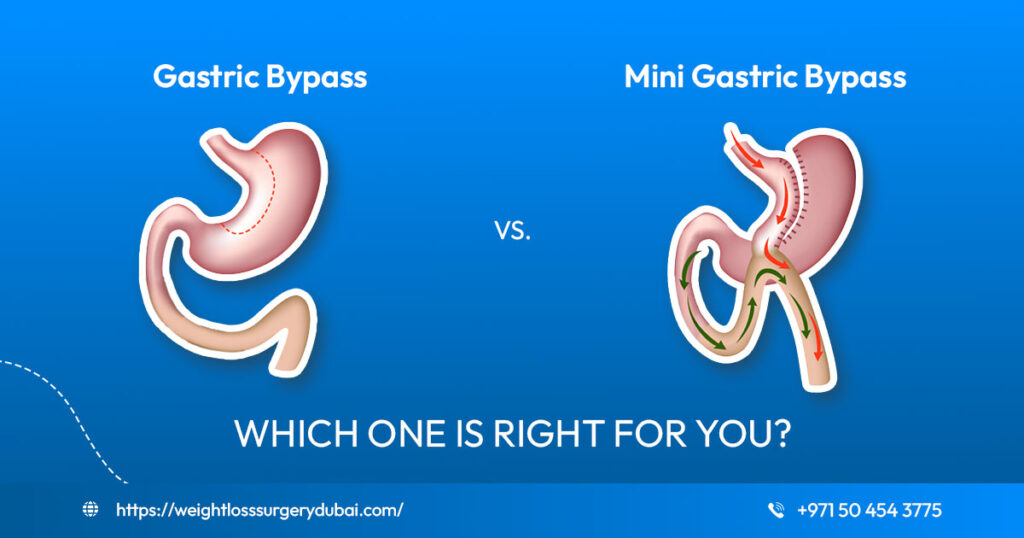
Choosing between Mini Gastric Bypass (MGB) and Roux-en-Y Gastric Bypass (RYGB) is a significant decision in your weight loss journey. Both procedures are effective bariatric surgeries, but they differ in technique, recovery, risks, and long-term outcomes. Here’s a comprehensive comparison to help you make an informed choice.
| Feature | Mini Gastric Bypass (MGB) | Roux-en-Y Gastric Bypass (RYGB) |
| Surgical Complexity | Single anastomosis; simpler procedure | Two anastomoses; more complex |
| Operation Time | Shorter (approx. 90–115 minutes) | Longer (approx. 150–205 minutes) |
| Hospital Stay | 2–3 days | 2–3 days |
| Weight Loss | 60–75% excess weight loss in 12–18 months | 60–80% excess weight loss in 18–24 months |
| Nutritional Deficiencies | Higher risk due to longer bypassed intestine | Moderate risk; requires lifelong supplements |
| Reflux Risk | Higher risk of bile reflux | Lower; often improves GERD symptoms |
| Reversibility | Easier to revise or reverse | More challenging to reverse |
| Long-Term Data | Emerging but promising | Extensive long-term outcomes |
MGB involves creating a long, narrow stomach pouch and connecting it to a loop of the small intestine, bypassing a significant portion of the stomach and duodenum. This single-anastomosis procedure reduces calorie absorption and alters gut hormones to promote satiety.
RYGB entails creating a small stomach pouch and connecting it to a section of the small intestine, bypassing the majority of the stomach and the first part of the small intestine. This dual-anastomosis approach restricts food intake and reduces nutrient absorption, leading to weight loss.
Pros:
Cons:
Pros:
Cons:
Consider Mini Gastric Bypass (MGB) if:
Consider Roux-en-Y Gastric Bypass (RYGB) if: